Sant Joan in Menorca: history, traditions, and why experiencing it from a Llaut is unforgettable
Every year on the 23rd and 24th of June, the island of Menorca celebrates one of the oldest and most intense festivals in the Mediterranean: the Sant Joan festival in Ciutadella.
More than just a summer celebration, Sant Joan is a centuries-old tradition that combines religion, medieval rituals, horses, music, and a unique atmosphere that transforms the whole island.
For locals, it is the most important event of the year.
For visitors, it is one of the most authentic cultural experiences you can live in Spain.
In this article, we explain the history of Sant Joan, the meaning behind its traditions, what really happens during the celebrations, and why spending these days on board a traditional Menorcan llaut can be one of the best ways to enjoy the festival.
Origins of the Sant Joan Festival: From Conquest to Living Tradition
A New Society in Menorca
On January 5th, 1287, King Alfonso III of Aragon landed in the port of Maó with the objective of conquering Menorca, the last Balearic island still under Muslim rule at the time.
The conquest was swift but intense. After several days of fighting, the decisive battle took place on January 17th, the feast day of Saint Anthony, leading to the defeat of the Muslim forces. Shortly after, the last Muslim ruler retreated with a small group to the castle of Santa Àgueda, the final stronghold of resistance on the island. By January 21st, the island had fully surrendered to the Crown of Aragon.
This marked the beginning of a new era: medieval Christian Menorca. The island was repopulated mainly by settlers from Catalonia, bringing with them a new culture, social structure, and way of life. The previous Islamic population was almost entirely displaced, many of them reduced to slavery.
The Birth of a Social Order
Following the conquest, Menorca was reorganized according to a strict hierarchical system, typical of medieval Europe. Society was divided into distinct estates:
the nobility, represented by knights
the clergy
the citizens
the peasants
the craftsmen (menestrals)
Each individual belonged to one of these groups by birth, with clearly defined roles and responsibilities.
The key distinction was privilege. The nobility and the clergy enjoyed significant advantages: exemption from certain taxes, access to political positions, and ownership of land. In contrast, the majority of the population — citizens, farmers, and craftsmen — formed the productive class, responsible for agriculture, trade, and craftsmanship.
This social structure would later become the foundation of the roles still represented today during the Sant Joan festival.
Guilds and Religious Brotherhoods
Within this structured society, people practicing the same trade organized themselves into guilds. These associations regulated production, ensured quality, and protected against fraud. Each guild had its own rules, symbols, and identity.
On the religious side, several guilds would often unite to form a brotherhood, known locally as an obreria. These brotherhoods were responsible for:
honoring a patron saint
maintaining a chapel or church
organizing religious celebrations
collecting donations to fund their activities
These organizations played a central role in both the religious and social life of the island.
The Obreries: A Collective Structure
The obreries were officially established by the island’s governing body, the Universitat General, and functioned as structured associations with representatives from different social classes.
Each obreria was governed by a board composed of members from various estates, ensuring a balance between social groups. These members were known as obrers, or later caixers, and each had specific responsibilities:
the ecclesiastical obrer, in charge of religious matters
the clavari, responsible for managing funds and donations
the craftsmen and peasant obrers, who organized collections and financed the festivities
Their main purpose was to maintain their religious site and organize celebrations dedicated to their patron saint, including masses, gatherings, and public festivities.
The Obreria of Sant Joan
The Obreria of Sant Joan d’Artrutx, documented as early as 1399, is at the origin of today’s Sant Joan festival in Ciutadella.
Its primary roles were:
to honor Saint John the Baptist
to maintain the hermitage of Sant Joan de Missa
to organize collections and fund the associated celebrations
Over time, its internal structure evolved, incorporating different representatives from the social hierarchy, including peasants and eventually the Caixer Fadrí in the 17th century.
The brotherhood celebrated two main events:
the feast of Saint John
the feast of Saint Elizabeth
What made the Sant Joan celebration unique was the obligation for members to travel on horseback from Ciutadella to the hermitage of Sant Joan de Missa, located outside the city. This practical necessity would become one of the defining elements of the festival: the central role of horses.
From Tradition to Continuity
After the Turkish attack on Ciutadella in 1558, which devastated the city, the obreries were reestablished in 1564. From that moment on, the role of the Obreria of Sant Joan became increasingly important.
Thanks to the strong involvement of the local community and the support of the island’s governing institutions, the celebration continued to grow in significance over the centuries.
This continuity is what allows Sant Joan to exist today not as a reconstructed festival, but as a living tradition, deeply rooted in the history and identity of Menorca.
The Selection of the Caixers
Originally, the members of the Obreria were elected by the island’s officials through a voting system, where candidates were chosen based on majority support.
Over time, this system evolved, and by the 20th century, the process became more structured. Today, the Caixer Senyor plays a key role in appointing the members of the group, maintaining a balance between tradition and modern organization.
The traditional roles of the Caixers: a medieval structure still alive today
One of the most unique aspects of the Sant Joan festival in Ciutadella is that the celebration still follows a social structure that dates back to the Middle Ages.
The riders who participate in the festival, known as the caixers, are not chosen randomly. Each of them represents a specific social class that existed on the island centuries ago.
This organization has been preserved almost unchanged for more than 600 years, which is why Sant Joan is considered one of the most authentic traditional festivals in Spain.
The main roles are the following:
Caixer Senyor
He represents the nobility. Traditionally, this role is held by a member of one of the historic noble families of Ciutadella. He is the symbolic leader of the celebration.
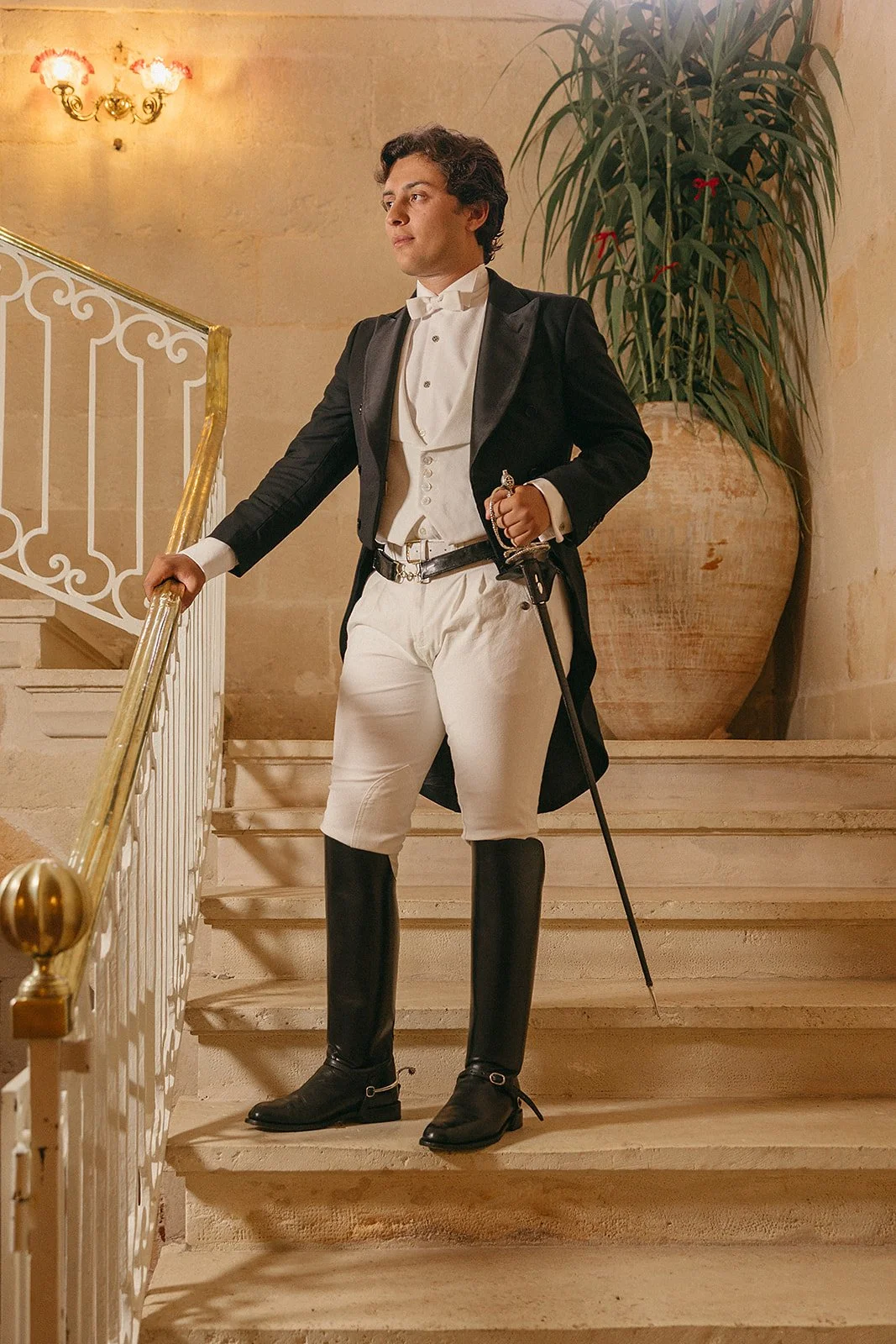
The Caixer Senyor
Caixer Capellà
He represents the Church. This role is given to a priest, reflecting the religious origin of the festival, which was originally organized in honor of Saint John the Baptist.
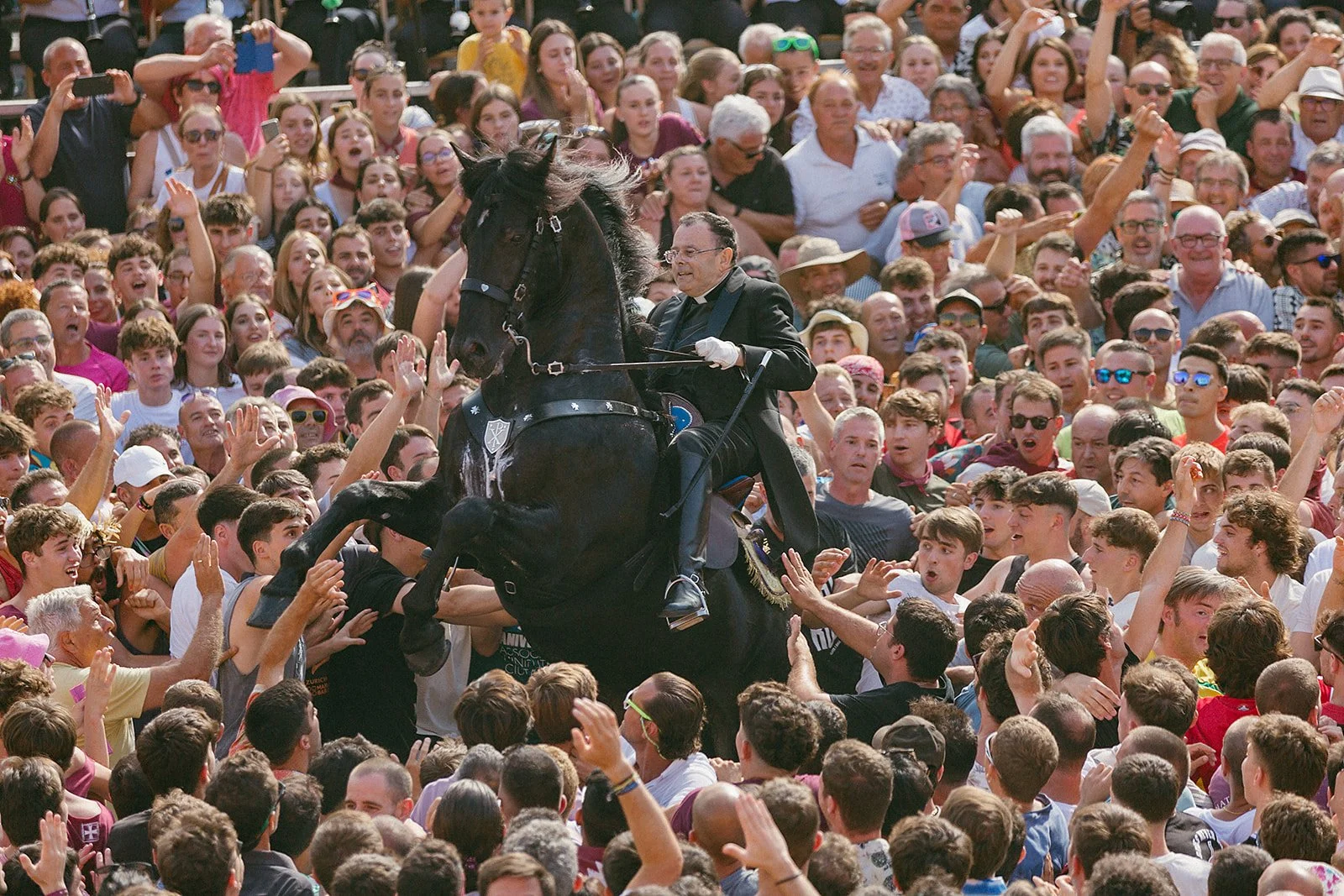
the Caixer Capellà
Caixer Casat
He represents the married artisans. In the old social order of Menorca, craftsmen had an important role in the life of the city, and this figure symbolizes stability, experience, and responsibility.
Caixer Fadrí
He represents the unmarried artisans. Traditionally younger, this role symbolizes youth, strength, and the continuation of the community.
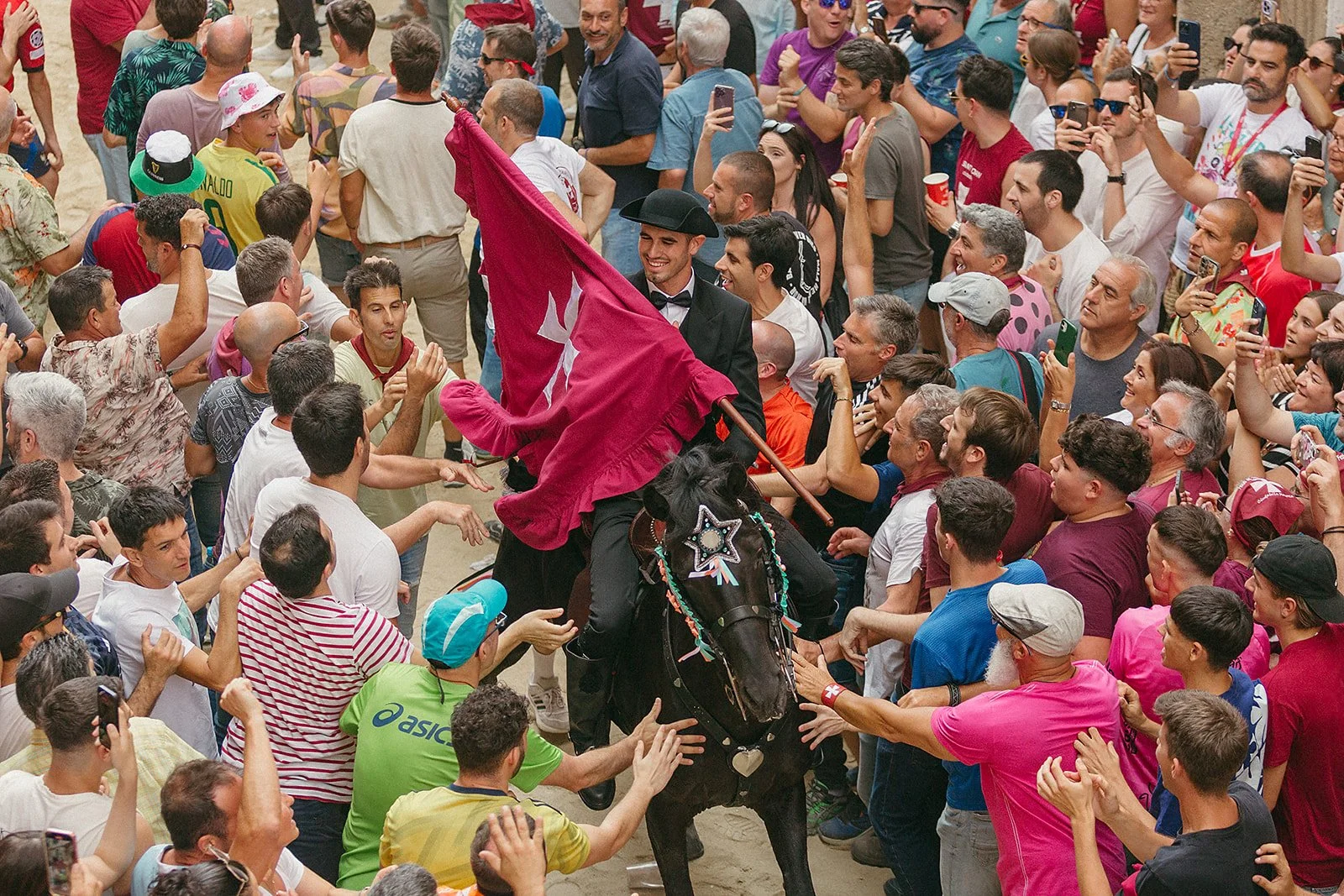
The Caixer Fadri
Caixers Pagesos
They represent the rural world. Farmers from different parts of the island participate in the celebration, showing the strong connection between Sant Joan and the countryside of Menorca.
The Fabioler
The fabioler is one of the most recognizable figures of the festival.
He walks at the head of the procession playing the fabiol (a small flute) and a drum.
His music announces the arrival of the riders and marks the beginning of the rituals. Without the fabioler, Sant Joan cannot begin.
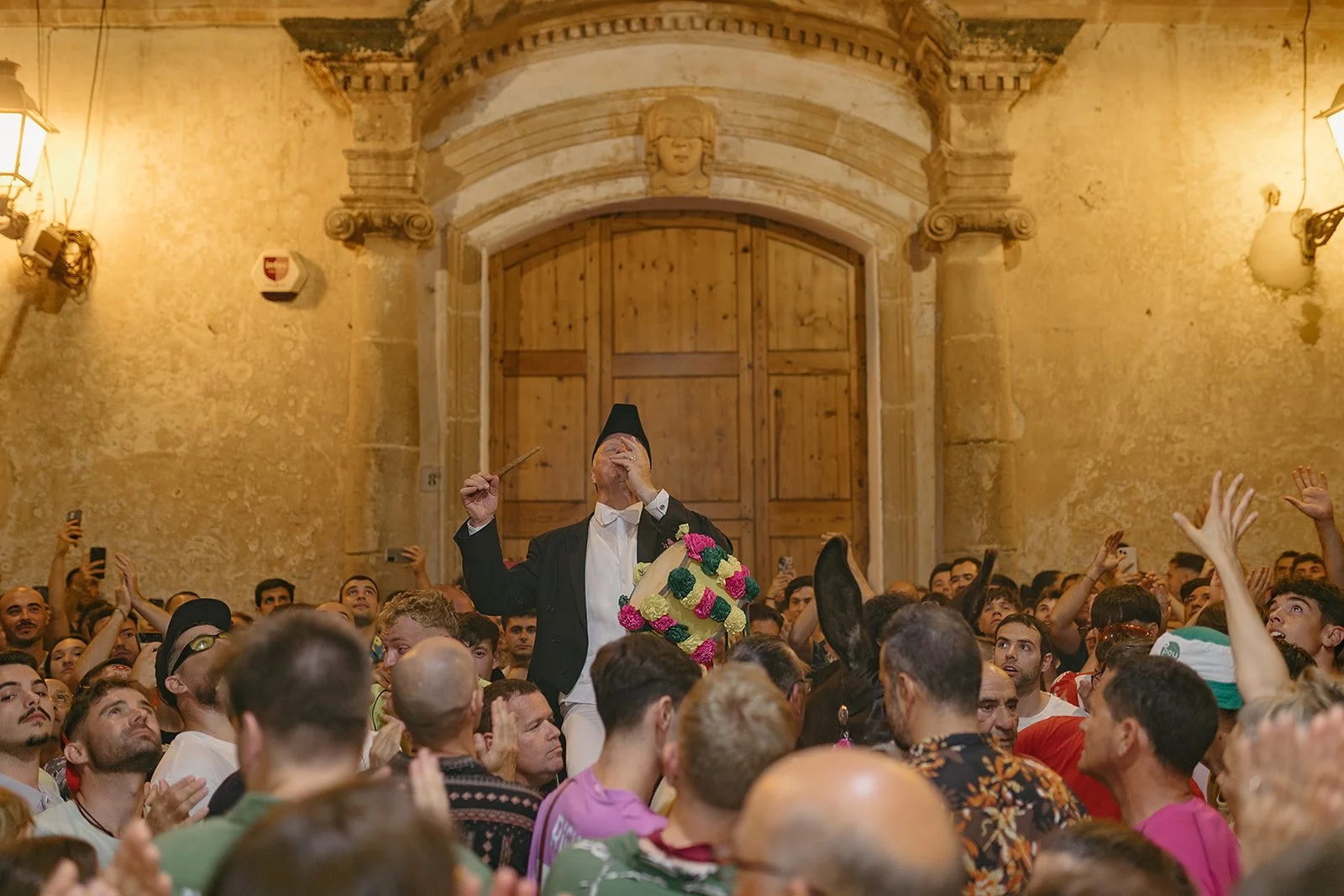
The Fabioler
Together, these characters form the qualcada, the official group of riders that moves through the streets of Ciutadella during the festival, following a strict traditional order that has been respected for centuries.
Why This Still Matters Today
What makes Sant Joan unique is that these roles — born from a medieval social system — are still represented today in the festival’s structure.
When the riders enter Ciutadella, they are not simply performers.
They are the living reflection of a society that existed more than 600 years ago.
The importance of horses in the Sant Joan festival
The true protagonists of Sant Joan are the Menorcan horses.
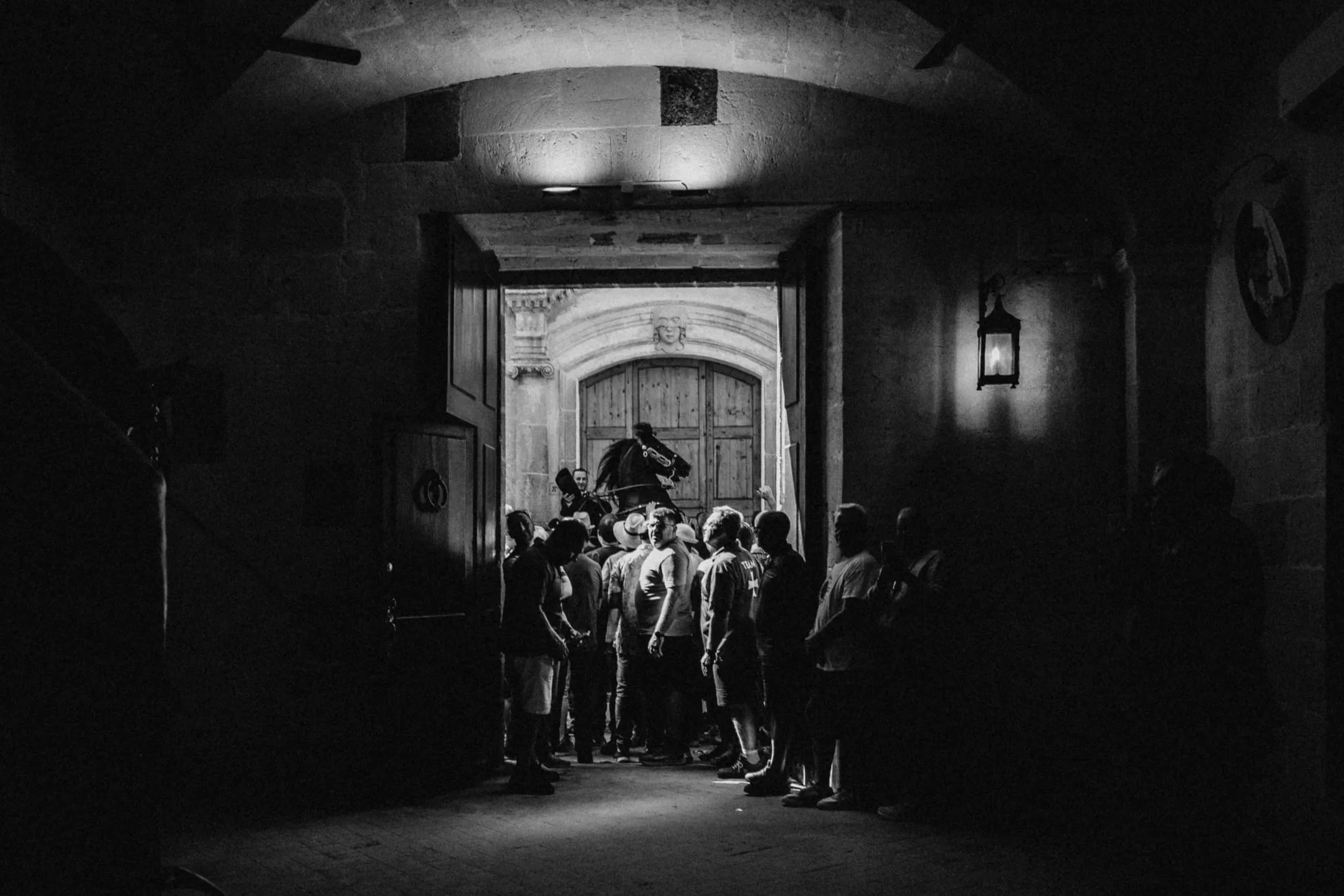
These black horses are trained to perform the famous jaleo, where riders make the horses stand on their back legs in the middle of the crowd while people try to touch them for good luck.
This moment is powerful, intense, and sometimes chaotic, but it is also deeply symbolic.
The horse represents strength, nobility, and the connection between the island and its rural past.
During Sant Joan, the streets of Ciutadella become a living stage where tradition and adrenaline mix together.
The main moments of the celebration
Sant Joan is not just one night.
It is a sequence of rituals that follow a very precise order.
Diumenge des Be: The True Beginning of Sant Joan
This is the name given to the Sunday before the 23rd and 24th of June, and it marks the official beginning of the Sant Joan celebrations.
On this day, the members of the Junta de Caixers gather at the residence of the Caixer Senyor, where an important symbolic act takes place: the Caixer Senyor hands over the flag to the Caixer Fadrí. At exactly 9:00 in the morning, the fabioler plays the drum and the fabiol for the first time, announcing the start of the festivities.
From that moment, the procession begins, following a strict and traditional order. The group visits the Town Hall, the Bishop, noble families, the riders who will take part in the qualcada, and the landowners who provide horses for the celebrations.
The most striking figure of this day is the homo des be, a unique character who only appears on this occasion. He is dressed in sheepskins, with crosses painted on his arms and feet, and carries a lamb on his shoulders. He represents Saint John the Baptist and embodies one of the oldest and most symbolic elements of the festival.
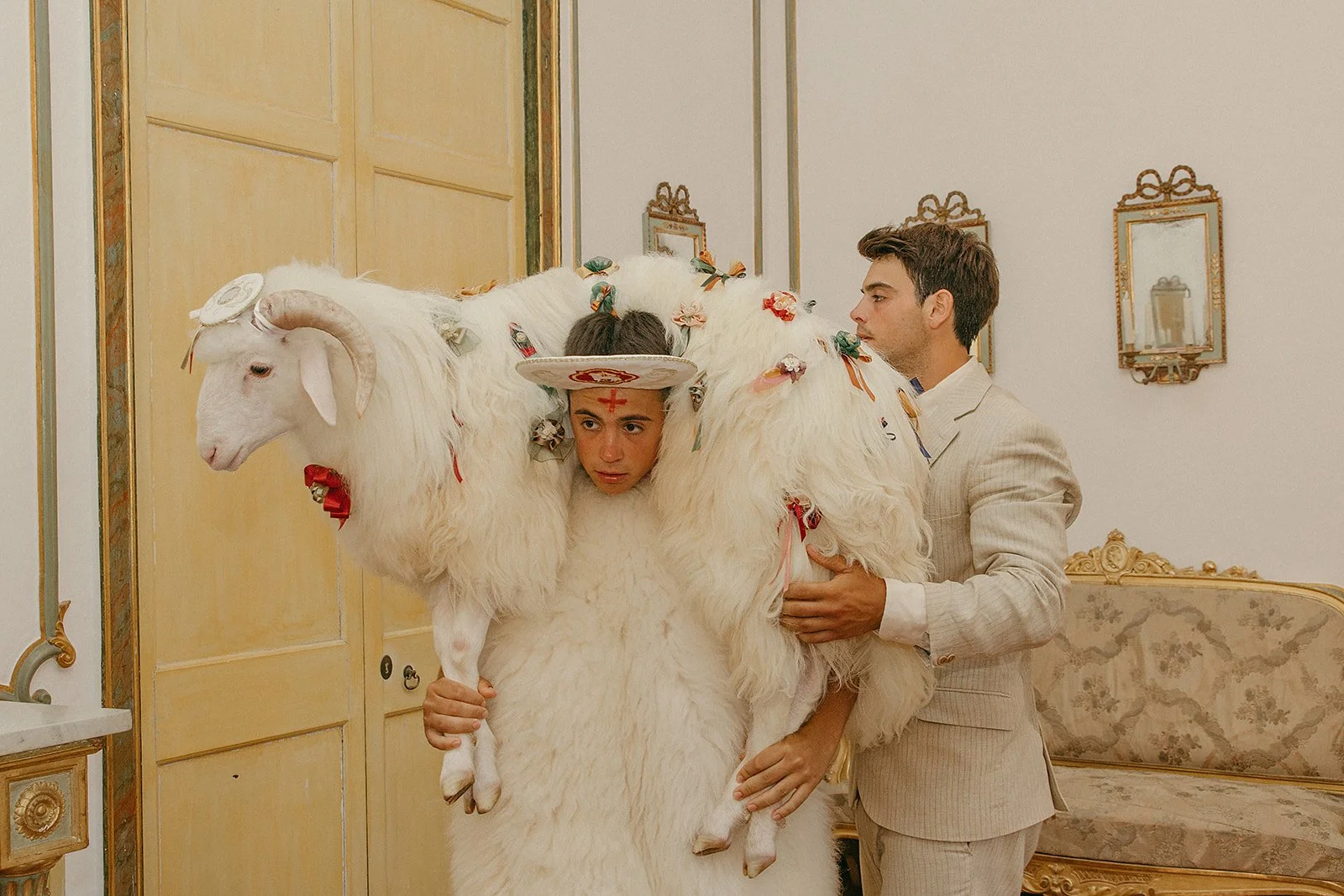
Homo des Be
Later in the evening, as the light fades, the first festive moments begin to emerge. On Avinguda de la Constitució, the first hazelnut throwing of the celebrations takes place, while in front of Bar Calós, the Municipal Band performs the first Jaleo, still without horses offering a first glimpse of the atmosphere that will soon take over the city.
Sant Joan Eve (23rd June): From the First Call to the Night Processions
On the afternoon of June 23rd, just before 2:00 pm, the fabioler, mounted on a small donkey, makes his way to the residence of the Caixer Senyor to formally request permission to begin the replec, the gathering of the qualcada (the official group of riders).
Once permission is granted, the fabioler steps forward and plays the primer toque del fabiol — the first official sound of the day. From the top of the steps, in front of the Caixer Senyor, the sharp notes of the flute and drum echo through the streets, while the crowd gathers below, already filled with anticipation.
This moment marks the true beginning of the Sant Joan Eve celebrations. As the music resonates, the atmosphere shifts instantly: the festival is no longer approaching — it has begun.
The fabioler then continues playing, and the replec starts. One by one, the riders join the procession, following a strict traditional order that has been preserved for centuries.
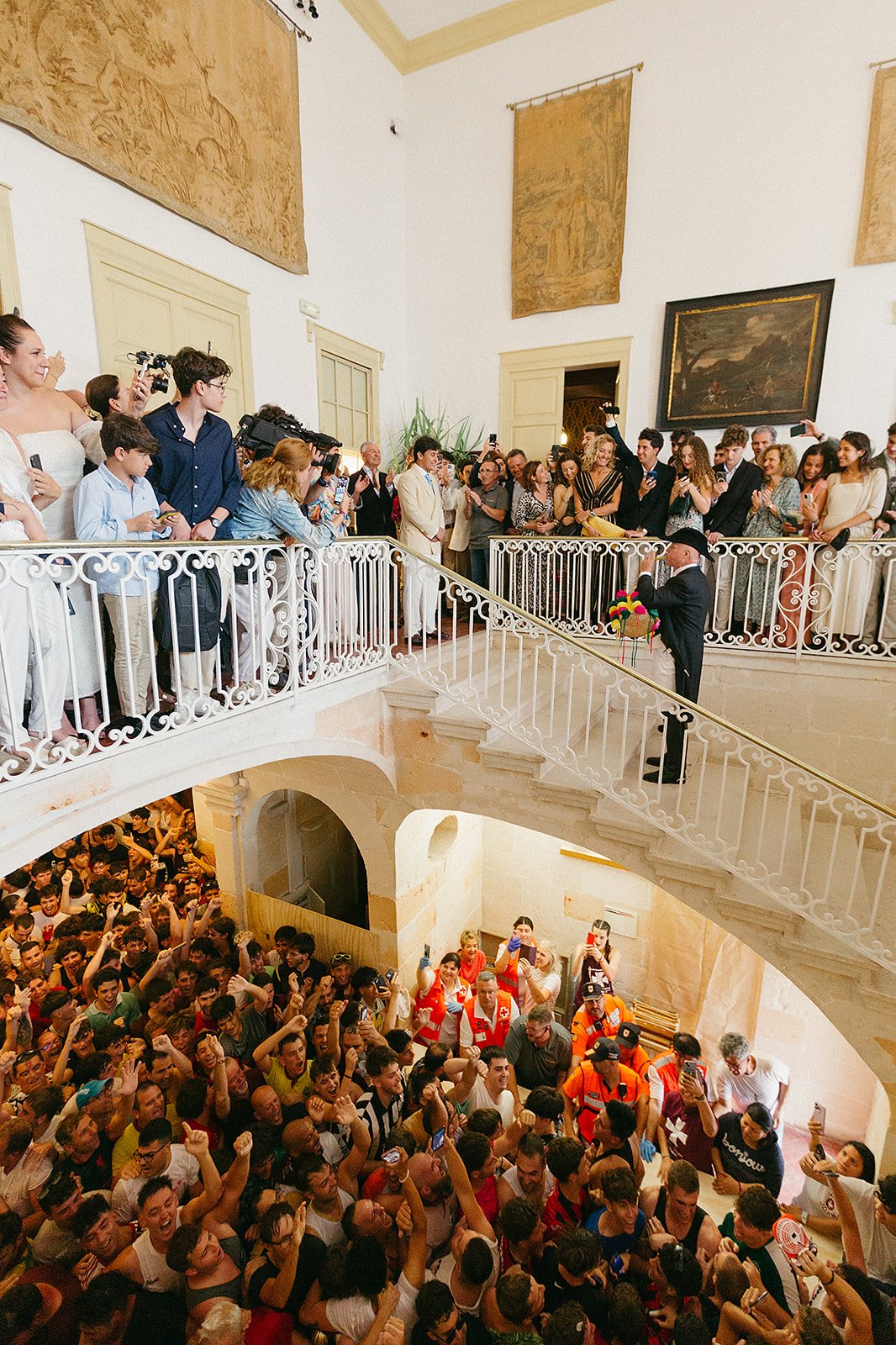
The primer toque del fabiol
A Visit to the Hospital
After the qualcada is assembled, the group heads to the Municipal Hospital. There, they parade through the square so that patients, watching from windows and balconies, can take part in the celebrations, even from a distance.
This moment reflects the communal spirit of Sant Joan — a festival meant to be shared by everyone.
Caragol des Born: The First Great Moment
As the afternoon progresses, the riders gradually enter Plaça des Born, positioning themselves along one side of the square.
At exactly 6:00 pm, the Caixer Senyor and the Caixer Capellà make their entrance at a gallop. As they salute the crowd, the music of the Jaleo suddenly erupts, and the Caragol des Born begins.
In the language of the festival, a caragol refers to a circular route, usually completed three times on horseback. During this event:
the first and third rounds are accompanied by the Jaleo music
the square fills with energy, movement, and sound
It is one of the most spectacular and joyful moments of Sant Joan.
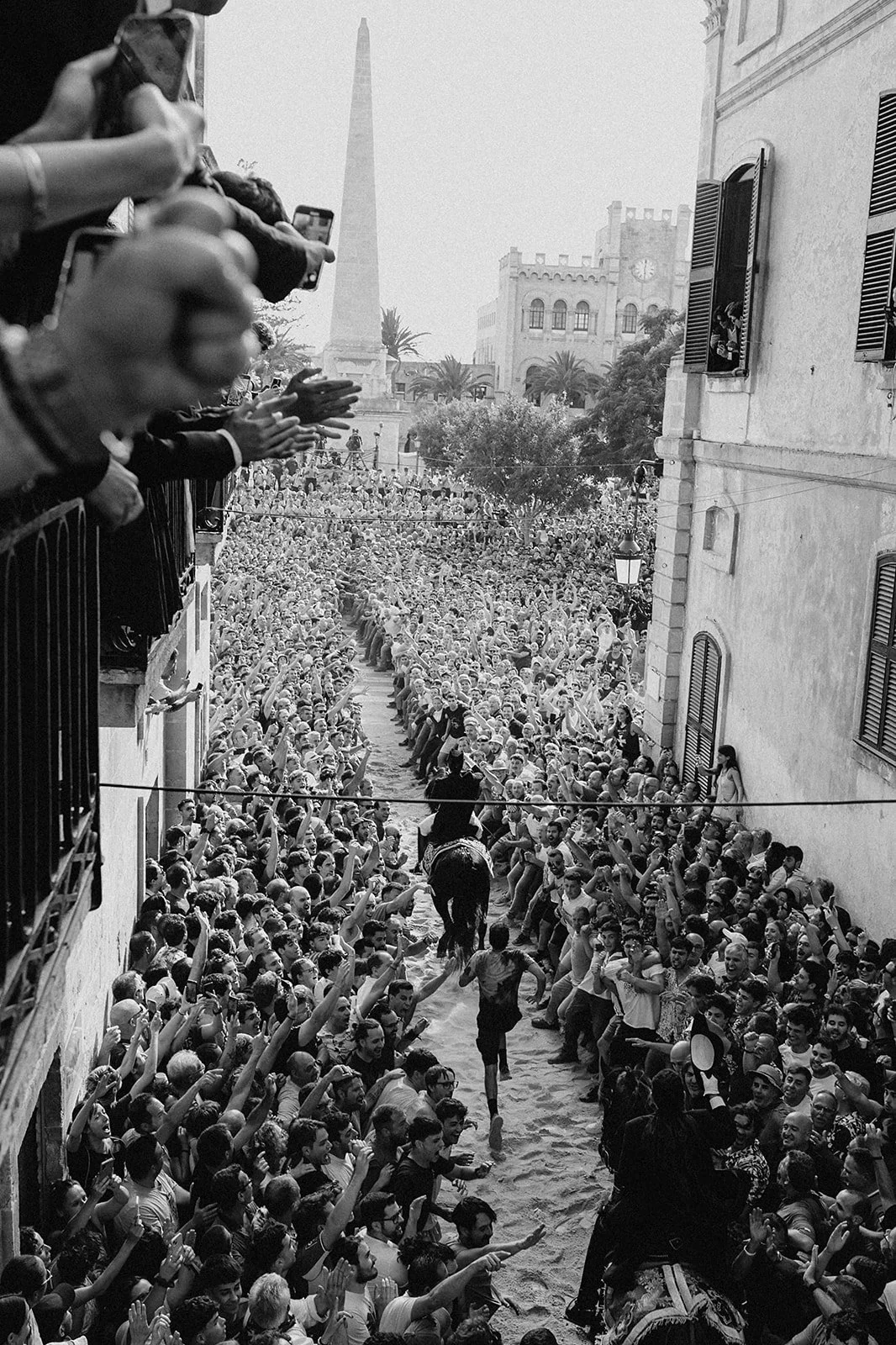
Caixer Senyor and Caixer Capellà entering at a gallop during the Caragol des Born
Journey to Sant Joan de Missa
Once the Caragol des Born is over, the qualcada leaves the square and heads out of the city towards the hermitage of Sant Joan de Missa, passing through Plaça d’Artrutx.
At the hermitage, the Vespers ceremony (Cant de Vespres) takes place, reconnecting the celebration with its religious origins.
Return at Sunset and “Córrer a sa Plaça”
At sunset, the riders return to Ciutadella through the streets, entering via Carrer de Sor Àgueda and continuing along the city walls.
They then take part in “Córrer a sa Plaça”, a series of runs between Plaça Nova and the Cathedral square, repeated three times. These runs highlight the skill of the riders and the agility of the horses.
Caragol de Santa Clara: Into the Streets and Homes
The procession continues with the Caragol de Santa Clara, a route through the narrow streets of the old town.
During this part of the celebration:
riders pass several times through the same streets
they enter the courtyard of the Santa Clara convent on horseback
they salute the building before continuing
One of the most unique traditions takes place here: horses are allowed to enter private houses, with the permission of the owners.
From doorways and windows, locals — children and elders alike — gently touch the horses’ heads (fer sa capadeta), creating intimate and emotional moments between people and animals.
The End of the Day
Later in the evening, once the horses are dismissed, the caixers and riders gather at the residence of the Caixer Senyor to share a traditional drink.
Finally, the group accompanies the Caixer Capellà to his residence, marking the end of the official celebrations of Sant Joan Eve.
Dia de Sant Joan (24th June): The Peak of the Celebration
Early in the morning, the fabioler is already back in the streets, beginning once again the replec. At around 8:00 am, he goes to the residence of the Caixer Senyor to request permission to start the day’s first ceremonies.
The Religious Heart of the Festival
The most important event of the morning — and the most significant from a religious perspective — is the Missa dels Caixers, held in the Cathedral.
Before the mass takes place, the qualcada heads to the Pla de Sant Joan, where the riders prepare for the afternoon by testing the traditional games they will later perform. They also take part in the Corregudes a ses Voltes and the Caragol de Santa Clara, continuing the ritual movements through the city.
After the mass, the Caixer Capellà hosts a traditional gathering at the Seminary, marking the end of the morning’s ceremonies.
Shortly after, the fabioler once again returns to the Caixer Senyor to formally request permission to begin the afternoon and evening events.
The Games of Sant Joan: Skill, Tradition and Risk
Following an official invitation at the Town Hall in Plaça des Born, the procession makes its way back to the Pla de Sant Joan.
This is where some of the most anticipated and intense moments of the festival take place. The riders perform two caragols — one at the beginning and one at the end — surrounding the traditional games:
L’ensortilla, where riders must spear a small ring at full gallop
Rompre ses carotes, a test of precision and control
Córrer abraçats, where two riders gallop side by side in close coordination
Together with the Caragol des Born of the previous day, these are among the most spectacular — and most dangerous — moments of Sant Joan.
To fully appreciate these events, attention is essential. The fabioler’s signals guide the action, and the public must respect the open passage reserved for the horses running at full speed. Without this awareness, not only is the spectacle lost, but safety is at risk.
The Closing of the Festival
Once the games and caragols at the Pla are finished, the qualcada returns to the city, following a similar route to the previous evening.
The festival concludes with the Caragol de Santa Clara and a final gathering at the residence of the Caixer Senyor.
For those who wish to experience the very last moments of Sant Joan, the night can extend a little further. In the early hours of the morning, the riders leave the Caixer Senyor’s house to accompany the Caixer Capellà back to his home.
There, in a quieter and more intimate atmosphere, the farewell takes place. One by one, the riders say goodbye, and in the silence of the night, the final notes of the fabiol and drum can be heard — bringing the festival gently to an end.
The Atmosphere in Ciutadella During Sant Joan
During Sant Joan, Ciutadella transforms completely. What is usually a quiet and elegant town becomes the beating heart of Menorca, where tradition, music, and movement take over every street.
From early morning until late at night, the old town is filled with people. The narrow streets echo with the sound of the fabiol, drums, and voices. Horses pass through the crowd, the energy rises with each procession, and the rhythm of the festival never really stops. Bars overflow onto the streets, terraces are packed, and the port itself becomes part of the celebration, with boats, lights, and people gathering along the waterfront.
It is an intense and unique atmosphere — one that mixes centuries-old tradition with a raw, almost electric energy. For many, this is exactly what makes Sant Joan so special: you are not just watching the festival, you are inside it.
But this intensity also comes with its challenges. During these days:
parking in Ciutadella becomes extremely difficult
the city center is constantly crowded, often packed shoulder to shoulder
hotels and accommodation are fully booked well in advance
noise continues throughout the night, with little pause
Moving through the streets can take time, and finding a quiet moment in the city becomes almost impossible.
For some visitors, this immersion is part of the magic — a chance to fully experience one of the most authentic festivals in the Balearic Islands.
For others, especially those looking to balance the excitement with moments of calm, having a place to step away becomes essential. A nearby refuge, where the noise fades and the pace slows down, can completely change the way Sant Joan is experienced — allowing you to enjoy the festival without being overwhelmed by it.
Experiencing Sant Joan from the Sea: A Perfect Balance Between Calm and Celebration
Spending Sant Joan in Ciutadella can be intense, but experiencing it from the sea offers a completely different rhythm, one that combines freedom, calm, and total flexibility.
The day often begins quietly on the water. Away from the crowds, the boat leaves the harbor and follows the coast of Menorca, where hidden coves, clear water, and soft morning light create a peaceful atmosphere. You can swim, relax on deck, and enjoy the slow movement of the sea, far from the noise of the city. The Balearic Islands reveal a different side here : calm, open, and deeply connected to nature.
As the afternoon light changes, you return to the harbor of Ciutadella, just minutes from the old town and the Sant Joan celebrations. From there, everything is simple. You walk into the festival, feel the energy of the streets, the horses, the music, the movement and stay as long as you want.
At any moment, you can step away from the crowd and return to the boat. No parking, no driving, no stress. Just a short walk back to the harbor, where the atmosphere shifts again: calm water, warm night air, and the soft reflection of the city lights on the sea.
The next day follows the same rhythm. Another morning on the coast, another swim in quiet waters, and the freedom to move between sea and celebration whenever you choose.
This is what makes experiencing Sant Joan from a boat so unique: the ability to live both worlds fully, the intensity of the festival and the peaceful beauty of Menorca’s coast.
Always at your own pace.
Special Sant Joan offer : 2 days / 1 night on board for two people
For the Sant Joan celebrations, we offer a special experience for two guests on a traditional llaut in Ciutadella.
The experience includes:
Accommodation on board during the festival
A unique location in the port, close to the old town
Total freedom to enjoy the celebrations at your own pace
A quiet and romantic place to return after the fiesta
This offer is ideal for couples who want to live Sant Joan fully, but also enjoy comfort, authenticity, and the charm of the sea.
Sant Joan only happens once a year, and the island feels different during these days.
Living it from the water makes it even more unforgettable.